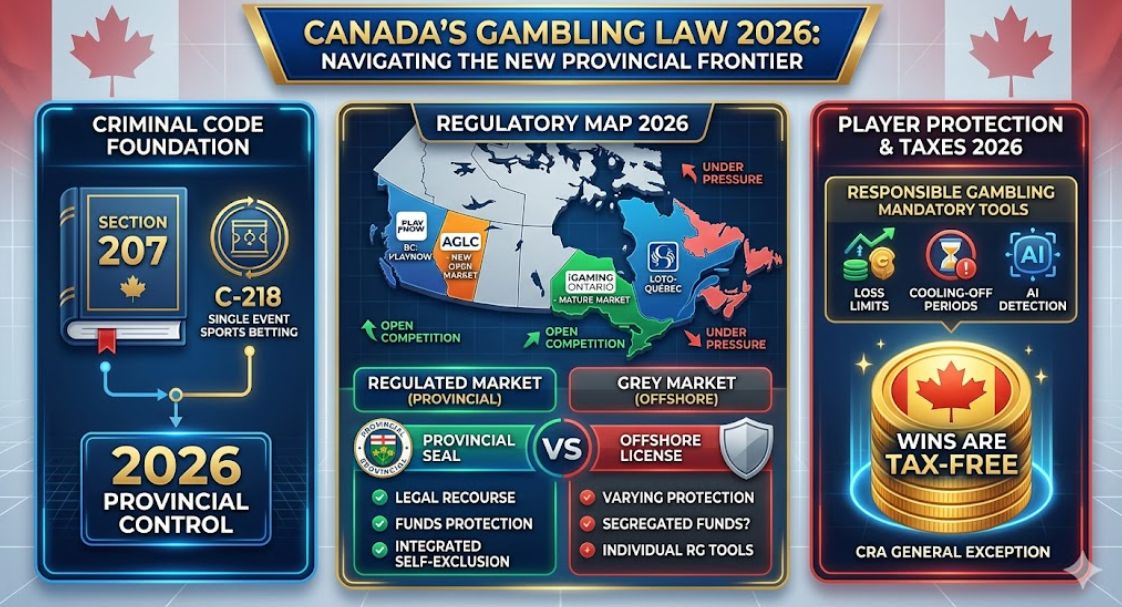
Navigating the legal landscape of gambling in Canada has always felt a bit like playing a complex strategy game. As of April 2026, the rules have shifted significantly, moving from a rigid federal monopoly to a vibrant, province-led digital frontier. For Canadian players, the question is no longer just “Is it legal?” but rather “Is it regulated in my province?”
In this expert review, we break down the current state of Canadian gambling law, the rise of provincial licensing, and what the future holds for players from British Columbia to Newfoundland.
The Foundation: The Criminal Code of Canada
To understand gambling in Canada, you have to start with the Criminal Code. Historically, all forms of gambling were illegal in Canada until the 1970s, when the federal government granted provinces the authority to “conduct and manage” gaming within their borders.
Sections 201 to 207: The Legal Anchor
The Criminal Code still contains strict prohibitions against “common gaming houses” and unauthorized betting. However, Section 207 provides the “carve-out” that allows provincial governments to operate lottery schemes, casinos, and online platforms.
In 2021, a landmark change occurred with Bill C-218, the Safe and Regulated Sports Betting Act. This removed the federal ban on single-event sports betting, allowing Canadians to bet on a single hockey game or UFC fight rather than being forced into “parlays” (betting on multiple games at once). This single piece of legislation acted as the catalyst for the modern iGaming explosion we see today.
The Ontario Model: A Blueprint for the World
Ontario is currently the crown jewel of Canadian gambling law. On April 4, 2022, the province launched its regulated iGaming market, and by 2026, it has matured into one of the largest and most successful jurisdictions in North America.
iGaming Ontario (iGO) and the AGCO
Ontario split its oversight into two distinct bodies:
-
Alcohol and Gaming Commission of Ontario (AGCO): The “Watchdog.” They handle the licensing of operators and ensure they meet strict integrity and player protection standards.
-
iGaming Ontario (iGO): The “Manager.” This agency enters into commercial contracts with private operators, allowing them to offer games on behalf of the province.
By mid-2026, Ontario’s market has grown to feature over 50 licensed operators, capturing nearly 90% of the betting volume that previously went to “grey market” or offshore sites.
The Alberta Evolution: The Next Big Player
Following Ontario’s massive success—which is projected to generate over $3.2 billion in gross gaming revenue this year—Alberta has officially entered the ring.
In Spring 2025, Alberta passed Bill 48 (the iGaming Alberta Act). As of April 2026, Alberta is in the final stages of launching its own open-market model. Much like Ontario, Alberta is moving away from the “PlayAlberta” monopoly and inviting major international brands to apply for local licenses.
For Albertans, this means:
-
More competitive odds on the NHL and CFL.
-
Better casino bonuses.
-
The security of knowing the Alberta Gaming, Liquor and Cannabis (AGLC) is overseeing every spin of the reel.
The “Grey Market” vs. Regulated Markets
One of the most confusing aspects for Canadian casino players is the existence of the “Grey Market.” These are online casinos based in offshore jurisdictions like Malta, Gibraltar, or Curacao.
Is it illegal to play on offshore sites?
Under current Canadian law, it is not illegal for a Canadian citizen to place a bet on an offshore website. The Criminal Code focuses on the operator rather than the player. However, playing on a regulated site (like those licensed in Ontario or Alberta) offers protections that offshore sites do not:
-
Legal Recourse: If a regulated casino refuses to pay your winnings, you have a government agency to appeal to.
-
Funds Protection: Regulated sites must keep player funds in separate, segregated accounts.
-
Responsible Gambling: Local sites are integrated into provincial self-exclusion programs.
| Feature | Regulated (e.g., Ontario/Alberta) | Grey Market (Offshore) |
| Legal for Canadians | Yes | Yes (Not prohibited for players) |
| Consumer Protection | High (Provincial Oversight) | Low (Varies by jurisdiction) |
| Tax on Winnings | $0 (For most casual players) | $0 |
| Local Support | Yes | Often No |
Responsible Gambling: The 2026 Standard
A major pillar of 2026 gambling law is the mandatory inclusion of Responsible Gambling (RG) tools. In Canada, regulators now require “liveness checks” and AI-driven monitoring to detect problem gambling patterns before they escalate.
Legally, every licensed site in Canada must now provide:
-
Loss and Deposit Limits: Set by the player daily, weekly, or monthly.
-
Cooling-Off Periods: Instant breaks ranging from 24 hours to 30 days.
-
Self-Exclusion: A permanent ban that is often shared across all licensed sites in the province.
Taxation: Good News for Canadian Winners
One of the best parts of Canadian gambling law is the tax treatment of winnings. In the eyes of the Canada Revenue Agency (CRA), gambling winnings are generally not taxable.
The logic is that since you are gambling with “after-tax” income, and the house has an edge, the CRA doesn’t view gambling as a reliable source of income. The only exception is if you are a professional gambler (i.e., your primary source of income is poker and you operate like a business), but for 99.9% of players, what you win is what you keep.
The Future: A Pan-Canadian Standard?
As we move through 2026, there is growing talk of a Multi-Provincial Agreement. Currently, Ontario and Alberta are separate islands. In the future, we may see provinces “pooling” their players for games like Online Poker, creating massive prize pools that can compete with the global market.
Summary of the 2026 Landscape
-
Ontario: Fully open, mature, and highly regulated.
-
Alberta: Newly opened and rapidly expanding.
-
BC, Manitoba, Quebec: Currently operate through government-run monopolies (PlayNow, Loto-Quebec) but are under pressure to open to private competition.
-
The Atlantic Provinces: Maintaining a conservative, government-controlled approach for now.
Final Expert Verdict
Gambling law in Canada has successfully transitioned from “prohibition” to “protection.” By moving toward a regulated model, provinces are keeping tax dollars at home, creating jobs, and—most importantly—ensuring that players have a safe environment to enjoy their favorite games.
Whether you are in Toronto, Calgary, or Vancouver, the key to a safe experience in 2026 is simple: Always check for a provincial regulatory logo at the footer of the casino website.
Are you curious if a specific offshore brand is safe for Canadians, or do you need help understanding the new KYC (Know Your Customer) identity verification rules in Alberta?