Summary
- RNG selects slot and pokie outcomes within the game’s mathematical rules. Under unchanged conditions, earlier wins or losses do not improve the next spin’s chances.
- Hot and cold streaks describe past results – not reliable predictions. A losing machine is not “due”, and a recent jackpot does not automatically make it stop paying.
- RTP describes long-term expected return across wagers. It is not a refund guarantee, a personal session target or a reason to keep playing.
- Timing the spin button, watching near misses or increasing bets after losses does not reliably predict or force a win.
- Persistent bonuses and some jackpot mechanisms can change game conditions under their stated rules. That is different from a machine compensating for ordinary losses.
- Set spending and time boundaries independently of results. Continuing to chase an expected payout exposes more money without creating any entitlement to a win.
Slot and Pokie RNG Explained: Why a Losing Machine Is Never “Due”
A slot machine does not become more likely to pay simply because it has been losing. Nor does a recent jackpot prove that the machine must now stop paying.
For conventional random slots and Australian pokies, each new base-game outcome is selected through a random number generator operating within the game’s approved rules. Previous wins and losses do not create a debt that the next spin must settle.
The key principle is independence: under unchanged game conditions, the result of an earlier spin does not improve or worsen the probability of the next one.
That does not mean every symbol is equally likely, every game has identical odds or every bonus uses the same rules. Randomness operates inside a carefully designed mathematical structure.
For Canadian slot players and Australian pokie players, understanding that structure is more useful than searching for a machine that looks “ready”.
What Is a Random Number Generator?
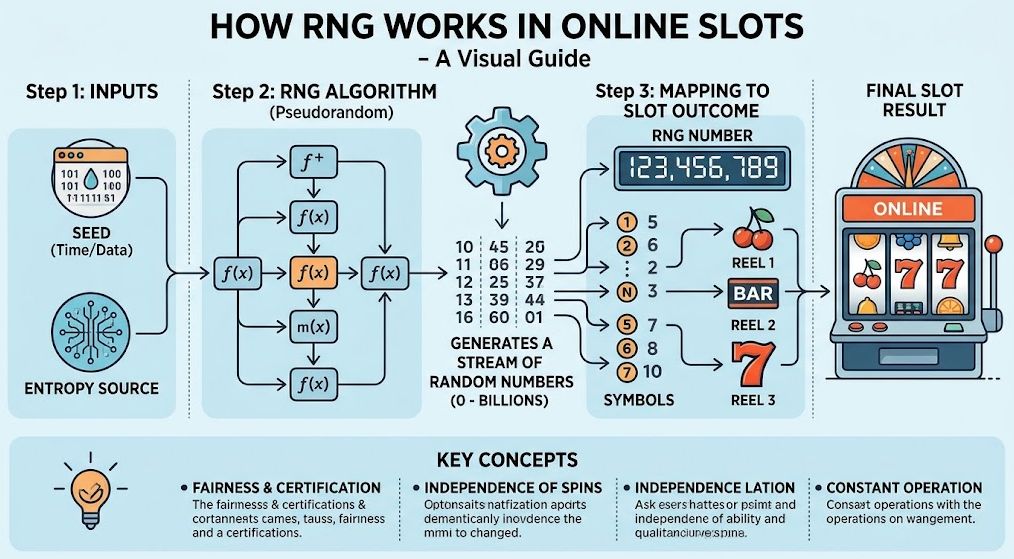
A random number generator, or RNG, is hardware, software or a combination of both that produces numbers used to determine game outcomes.
In a slot, those numbers are translated into results through the game’s mathematical model.
The reels, symbols and animations communicate the outcome. They are not a visible window into the generator’s internal sequence.
Many electronic games use a pseudorandom number generator. This is a mathematical process designed to produce an unpredictable sequence with the required statistical properties.
“Pseudorandom” does not mean a player can recognise the next result from previous spins.
A properly implemented system protects its internal state and starting information. Watching the reels does not provide the information needed to predict its output.
What Happens When You Press Spin?
The details vary between products, but the general process is:
-
The system accepts the wager and applicable selections.
-
Random values are obtained.
-
Those values are mapped to outcomes under the game’s rules.
-
The game determines any qualifying prize or feature.
-
The result is displayed and the balance updated.
Some games involve several random selections, especially during free games, pick features or multi-stage bonuses.
Therefore, “everything is always decided in one instant” is too broad a description of every product.
The important point is that stopping a visual reel does not normally let you alter an already selected result.
An interactive feature should explain whether your choice genuinely affects the award or simply reveals it.
Random Does Not Mean Every Symbol Has Equal Odds
An RNG can produce uniformly distributed numbers while the game gives different symbols very different probabilities.
The distinction is mapping.
Imagine a simplified system with 100 equally likely number values. If one value maps to a jackpot outcome and 50 map to an ordinary result, those outcomes are not equally likely.
Real slot mathematics can be considerably more complex, involving reel strips, weighted selections and multiple stages.
A screen containing five familiar symbols does not mean each symbol appears one-fifth of the time.
Likewise, a large jackpot image does not occupy the same mathematical probability as a small-paying symbol simply because both appear in the artwork.
Random selection and unequal prize probabilities are entirely compatible.
Why Hot and Cold Streaks Happen
Random results do not alternate neatly between wins and losses.
They naturally include clusters, gaps and sequences that look meaningful.
A player might receive several small prizes close together, then experience a long stretch without a qualifying return.
That sequence does not require the machine to switch between hidden “generous” and “stingy” modes.
“Hot” and “cold” can describe what happened over a selected period. They do not reliably describe what will happen next.
The period itself also matters. A machine can appear hot over ten spins and disappointing over the full evening.
Without a defined measurement, those labels often reflect whichever part of the session someone remembers most clearly.
The Gambler’s Fallacy: Why a Machine Is Not Due
The gambler’s fallacy is the belief that an independent random event becomes more likely because it has not occurred recently.
For example: “The bonus has not appeared for ages, so it must be close.”
Suppose a hypothetical feature has a constant 1% chance on each qualifying spin. After many unsuccessful spins, the next qualifying spin still has a 1% chance.
The earlier misses do not accumulate into a stronger next-spin probability.
That example does not describe every real game’s feature frequency. It illustrates independence.
A published average of one feature per hundred spins would also not mean a guaranteed feature within each block of one hundred.
An average is not a timetable.
The Opposite Myth: A Winning Machine Will Keep Winning
A recent run of prizes does not establish continuing momentum.
A player may interpret three good results as evidence that a machine has entered a favourable cycle. Another may see the same results and decide it has exhausted its payouts.
Both interpretations assign predictive meaning to the same history without a valid basis.
Under unchanged conditions, the next independent outcome is not improved by confidence or reduced by suspicion.
A useful distinction is between:
-
Observing a recent run.
-
Predicting the next result.
-
Knowing the game’s underlying probabilities.
Only the first is established by watching a handful of spins.
A striking sequence can be real without being a usable forecast.
Does the Machine Need to Recover a Jackpot?
For conventional independent slots, a large payout does not create an instruction to take money back from the next customer.
The game’s expected return comes from its probability and award structure, not a need to rebalance each session.
This remains true even when the payout is financially significant to the player.
However, jackpot state can matter in a different way.
A progressive jackpot may reset to a lower amount after it is won. That changes the advertised prize amount under the jackpot’s rules.
It does not automatically mean the base game has entered a cold phase.
Prize size, jackpot eligibility and base-game probabilities should be considered separately.
RTP Explained Without the Refund Myth
Return to player, or RTP, is the theoretical proportion of wagers returned as prizes over the long term under a specified configuration.
A hypothetical 96% RTP game has an expected long-run return of 96 units for every 100 units wagered.
It does not promise that a player depositing C$100 or A$100 receives 96 dollars back.
The calculation concerns turnover, not deposits.
If prizes are repeatedly wagered, total turnover can exceed the original amount inserted.
Nor does the game check each customer’s result and top them up to 96%.
Short sessions can finish far above or below the theoretical return.
A mathematically compliant game can still produce a complete loss of the amount a person chose to play.
Does RTP Have to Catch Up?
No individual machine needs to correct a short run by producing a compensating payout on demand.
The law of large numbers describes how observed averages tend towards expected values as the number of observations grows.
It does not require the next outcomes to reverse earlier results.
A shortfall can become less significant relative to a much larger volume of subsequent play without the game repaying a particular player.
There is also no universal spin count at which the displayed return must exactly equal the theoretical RTP.
Volatility and rare large awards can create substantial variation.
Playing longer to “reach the RTP” increases exposure to further wagering. It does not create a refund entitlement.
RTP, Hit Frequency and Volatility Are Different
These three measures answer different questions.
| Measure | What it describes | What it does not promise |
|---|---|---|
| RTP | Long-term expected prize return relative to turnover | A personal session result |
| Hit frequency | How often a defined prize event occurs | That each event exceeds the stake |
| Volatility | How outcomes vary around the expected result | A predictable hot or cold cycle |
Two games can share an RTP but distribute prizes differently.
One may produce relatively frequent modest awards. Another may place more value in less frequent larger outcomes.
A “win” animation can also accompany a return smaller than the total wager.
For example, receiving 40 cents after staking one dollar is a net loss of 60 cents, regardless of the sound effects.
Near Misses Are Not Progress
Two jackpot symbols and a third just outside the winning position can feel close.
That visual impression does not make the following spin more likely to complete the combination.
For an ordinary independent outcome, a near miss is an unsuccessful result—not partial credit towards a future jackpot.
This differs from a genuine collection mechanic that visibly retains progress under stated rules.
The distinction should be explicit:
-
A near miss does not inherently carry forward.
-
A persistent feature can retain a defined state.
-
The paytable explains which situation applies.
Do not infer a mathematical advantage from how close a symbol appears to the payline.
Visual distance and probability are different concepts.
Does Timing the Spin Button Help?
GambleAware NSW explicitly rejects timing strategies as a way to improve pokie outcomes.
Waiting five seconds, playing at a particular hour or synchronising a press with an animation does not provide a reliable advantage.
In some implementations, changing the exact timing could change which random value is used. That does not mean the player can identify a favourable value or improve the odds.
This is an important technical distinction.
A different result is not necessarily a better probability.
The same applies to stopping reels or repeatedly pressing a button. Unless a genuine skill component is clearly explained, the interface should not be treated as a timing challenge.
Does Increasing Your Bet Unlock a Win?
A higher wager does not force the RNG to produce a favourable result.
However, bet settings can change disclosed game conditions.
A larger stake may scale prizes, enable additional paylines or change eligibility for a feature or jackpot.
Those are rule changes, not evidence that the machine rewards persistence.
Check exactly what changes before increasing the bet.
A higher maximum prize can come with greater financial exposure and does not establish better value.
Betting systems that raise stakes after losses also do not remove the house advantage.
They can turn an ordinary losing sequence into a much larger financial loss.
What About Persistent Features and Bonus Meters?
Not every slot resets to an identical visible state after every spin.
Some games retain collected items, build a meter, change reels during free games or enter a different bonus phase.
These are legitimate game-state changes when implemented under the applicable rules.
The precise statement is therefore not “nothing that happened before can ever matter”.
It is that past ordinary losses do not, by themselves, make a future independent win due.
A retained feature can affect the next game’s conditions. That does not automatically create a profitable opportunity.
Read what the meter actually does. A visual pot that grows may be decorative, stateful or linked to a specific trigger mechanism.
Do not guess from animation alone.
Are Must-Hit-By Jackpots an Exception?
Some jackpots have a disclosed upper threshold by which they must be awarded.
Their mechanics differ from an ordinary fixed-probability base-game prize.
A jackpot’s current state can therefore be relevant under its specific design.
However, that does not establish that the next spin must win, that a particular player will receive it or that the underlying slot has become hot.
The trigger method, eligible wagers and contribution rules matter.
Do not transfer a must-hit-by explanation to a jackpot without that feature.
Equally, do not assume every progressive jackpot has an approaching deadline simply because its displayed amount is high.
The applicable rules—not the size of the number—determine the mechanism.
Random Games Versus Compensated Games
“RNG” alone does not describe every historical gaming product in every jurisdiction.
Some markets have permitted compensated machines that adjust aspects of play using previous intake or payouts.
The UK Gambling Commission distinguishes those products from fully random games.
That distinction should not be imported casually into Canadian casino slots or Australian pokies.
Ontario standards require relevant chance-based outcomes to be independent and prohibit manipulating valid random output through a secondary decision.
Australian public guidance likewise explains ordinary pokies as independent random games.
The useful conclusion is specific: do not apply stories about compensated amusement machines elsewhere to the regulated random slot you are reviewing.
Can Loyalty Cards or Player Accounts Change the Odds?
A loyalty account can identify a customer and record activity. That does not establish that it changes ordinary random outcomes.
Ontario standards require protection against player or operator influence over random selection, subject to disclosed game conditions.
Keep loyalty benefits separate from game mathematics.
An offer of points, food credit or a promotion is not the same as altering a spin’s probability.
Likewise, a cashless wallet changes payment handling, not automatically the RNG.
If a game provides a clearly disclosed promotional feature, assess that feature on its own terms.
An unexplained losing session is not evidence that a loyalty card has instructed the machine to take more money.
How RNG Testing Works
Regulated systems are assessed against applicable technical requirements.
Testing can examine statistical independence, unpredictability, output distribution, outcome mapping and protection against interference.
Ontario’s AGCO describes analysis involving millions of data points as part of its RNG testing work.
Its internet-gaming standards also require relevant games and components to be approved or certified through the applicable process before use.
Testing does not mean every short session looks balanced.
Nor does a certification logo copied onto a website prove that every product there is authorised.
Canada’s regulatory arrangements vary by province, and Australian requirements vary by jurisdiction and venue category.
Verify the relevant local authority rather than treating one regulator’s standards as worldwide approval.
What to Do if You Suspect a Fault
An unusual streak is not, by itself, proof of malfunction.
A wrong credit deduction, inconsistent award or unresolved transaction is a different issue.
Record the game, time, stake, round identifier and displayed balance where available.
Stop wagering while the problem is reviewed.
Use the venue or operator’s complaint process, then the appropriate regulator if necessary.
A clear record is more useful than describing the game as cold.
Do not buy an RNG predictor or pay someone claiming they can decode the next result from screenshots.
A properly secured RNG is specifically designed to make that prediction impractical.
Final Verdict: Streaks Describe the Past, Not the Next Spin
The most reliable way to understand slots and pokies is to separate random selection from game rules.
RNG supplies unpredictability. The mathematical model determines probabilities and prizes. RTP describes long-term expectation. Features can change the game state when their rules say so.
None of that turns ordinary losing streaks into a promise of recovery.
For Canadian and Australian players, the practical lesson is the same: choose spending and time boundaries independently of recent results.
Stopping does not sacrifice a payout you were owed.
Continuing because a machine feels due commits more money to an outcome that remains uncertain.
Sources
- GambleAware NSW: Independent pokie outcomes, timing myths and hot-machine beliefs
- AGCO: Casino electronic gaming standards covering RNG independence, mapping and protection against influence
- AGCO: Ontario internet-gaming standards, random outcomes, disclosed conditions and certification
- AGCO: Technical assessments and RNG testing using large statistical datasets
- UK Gambling Commission: Definitions of RNG, mapping, scaling and compensated games
- UK Gambling Commission: How random and compensated games achieve theoretical return percentages
- UK Gambling Commission: Randomness, unpredictability and restrictions on adaptive behaviour